Connect with us

Opinion

Book Review: Compelled to Action: Struggle for Self-Determination by Maj. Gen. Katirima Manoni Phinehas

Birondwa Frank

Published

on

COMPELLED TO ACTION Struggle For Self-Determination, Authored by Maj. Gen

Compelled to Action

Major General Katirima Manoni Phinehas’s Compelled to Action is not a typical war memoir. It is a disciplined strategic account of one of post-colonial Africa’s few successful revolutions, told from the inside by a key architect. Dispelling any notion of romantic idealism, it presents the Ugandan bush war as a necessary, rationally organized response to a failed state, offering a masterclass in the mechanics of liberation.

The Revolutionary’s “Class Suicide”
The book’s central, powerful idea is “class suicide.” Katirima frames the decision of educated elites to abandon the path to bourgeois comfort for the uncertainty of guerrilla warfare as a deliberate, radical rupture. His heart “beating like a machine gun” symbolizes this visceral clash between intellectual training and the raw reality of armed struggle. This was not a reckless leap, but a compelled action—a rational response by students and professionals to blocked political participation, economic exclusion, and systemic state collapse. The revolution’s potency stemmed from this fusion of peasant grievance with intellectual and working-class discipline.

Discipline as a Template for Success
The memoir’s core value is its forensic focus on revolutionary organization. Katirima traces the FRONASA–UPM–PRA–NRA continuum not as a triumphalist march, but as a deliberate learning process. He underscores the pillars that distinguished this struggle:

  • Ideological Coherence: Grounding action in a clear political programme (e.g., the Ten-Point Programme).

  • Political Education: Building shared purpose across class lines to manage internal contradictions.

  • Rural Mobilization: Earning legitimacy and building power from the ground up, not from foreign capitals.
    This emphasis on internal agency and strategic discipline provides a critical blueprint, contrasting sharply with the many African liberation movements that failed after victory.

An Honest Anatomy of Struggle
Katirima’s narrative is notable for its sober honesty. He avoids triumphalism, acknowledging the costs, fears, and miscalculations inherent in guerrilla warfare. He does not obscure the tensions within the revolutionary coalition but shows how a shared political purpose was used to manage them. This grounded approach strengthens the book’s credibility as a serious political document, not just a personal story.

Pan-African Significance
From a continental perspective, the book functions as a pivotal case study. The NRA/NRM’s success in seizing and consolidating state power stands as a rare exception in post-colonial Africa. Katirima’s account implicitly asks a profound follow-up question: Why have so few revolutionary movements achieved this, and why do even successful ones struggle with lasting transformation? It moves beyond nostalgia to offer an instructive, clear-eyed examination of the prerequisites for—and the enduring challenges of—genuine self-determination.

The Strategic Core of a Revolution
Compelled to Action is an essential and compelling read. Its accessible prose and strategic clarity make it indispensable for anyone seeking to understand not just Uganda’s history, but the practical mechanics of revolutionary change. Katirima provides the critical link between the why of rebellion (compulsion, “class suicide”) and the how of its success (discipline, ideology, organization). For students of African politics, military strategy, or liberation theory, this book is a foundational text—instructive, intellectually grounding, and sharply relevant.

Loading

Opinion

Direct Democracy as a Trojan Horse for Imperialism

Birondwa Frank

Published

on

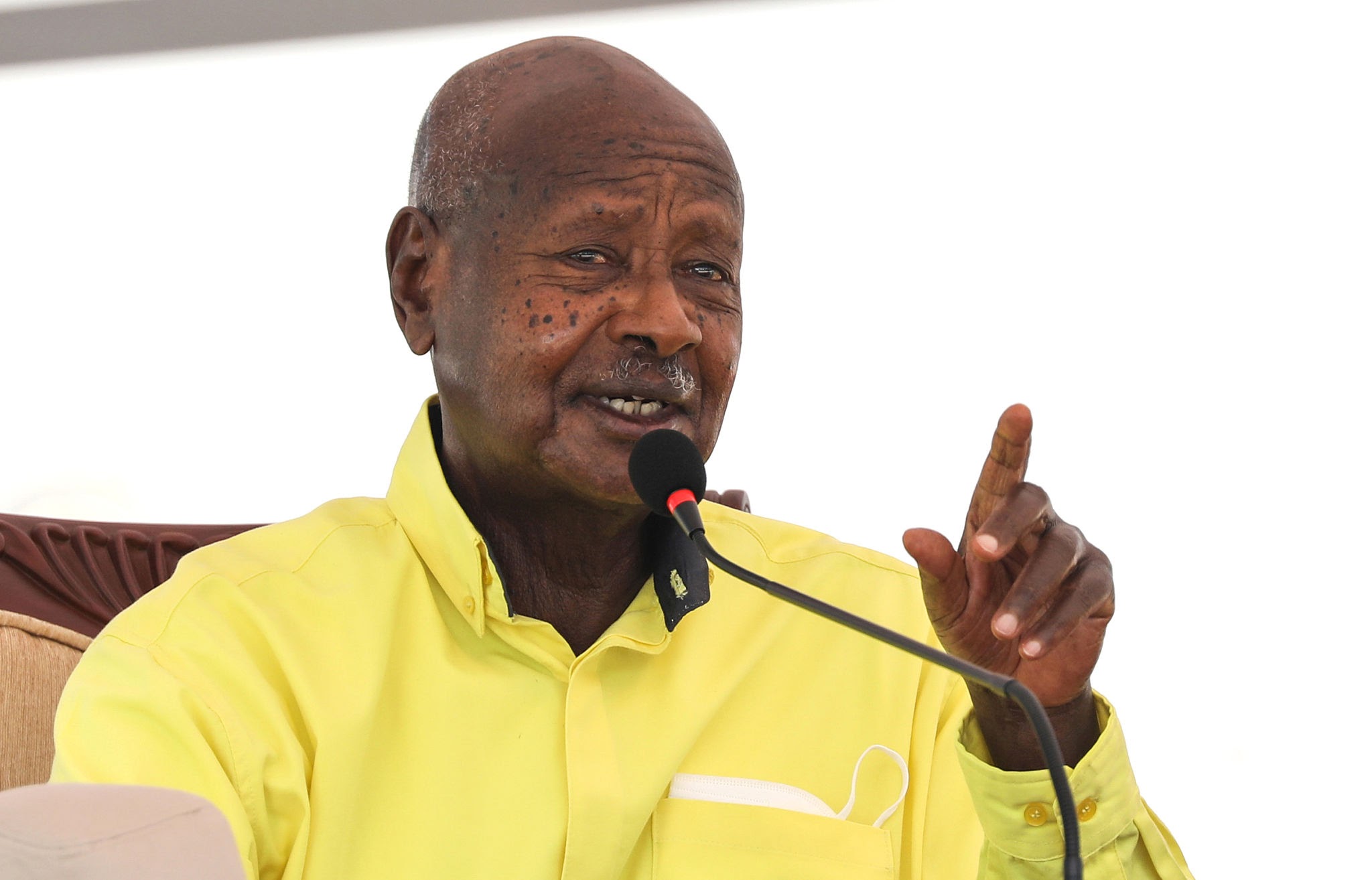
Yoweri Museveni Tibuhaburwa Kaguta (Photo by Hajarah Nalwadda/Getty Images)

When Plato and the Enlightenment philosophers sat down to map out the ideal Republic, they came face to face with a problem: the “uninformed mass.” They idea that a raw headcount of masses as a governance strategy quicly became a means for the rise of leaders with “talents for low intrigue” who can play a crowd like a fiddle while leading them off a cliff. I’m thinking of this in the context of our Elections in Uganda but also relevant to recent ones in Tanzania, Kenya, etc.

We consider the United States the world’s leading democracy, yet in that country “masses” do not elect the President. They never have since the founding of the states. They masses simply elect “Electors”—an elite intermediary designed to filter out impulsive, populist madness while staying on course with national interests. The U.S. is not a direct democracy; it is a carefully crafted elite representative republic.

If you were to take the raw, unfiltered direct elections currently practiced in Uganda and transplant them into the United States tomorrow, the superpower would collapse in a single election cycle. The “mob” would bypass the institutions, and the delicate balance of the union would shatter. No questions about it.

So if the West cannot fathom the idea of a raw headcount that you’re voting a president, why do they export it, often at the cost of war, to former colonies of imperial powers. Because they know that without intermediaries, elections become a psychological war. Direct Presidential Elections are not the “best” way to govern, but they are the easiest method to destabilize a nation. Masses oblivious of the interests and forcesthey come with in a country, add foreigh funds through comprador politicians

In the African context, this is exacerbated by the “ethnic pulse.” When you have a raw headcount in a society where people naturally gravitate toward their “own,” you aren’t electing a leader; you are conducting a census of which tribe is the largest. By forcing a Presidential system—a winner-take-all prize—on former colonies, the West essentially weaponized ethnicity. It is a system that invites secessionism as a political tool because, in a raw headcount, the minority is not just outvoted; they are erased.

Uganda: From Good to Great, or Back to Warlords?

Change and Time are two sides of the same coin. For 40 years, Uganda has moved from the chaos of any “interested warlord” seizing power to a qualitative baseline of stability. But we are at a crossroads. Meaningful change must move from “good” to “great,” not backward to the era where the economy and the suffrage of citizens were run down by the whims of a strongman.

We cannot afford to be “wishful thinkers” dreaming of a Uganda that never existed. We must deal with the one that exists now.

The Missing Ingredient: Where are the Makers?

The ultimate tragedy of this political toy-playing is our economic stagnation. History doesn’t side with the dreamers; it sides with the builders.

  • Why are the Ugandan rich merely traders in foreign goods?

  • Why have our elites become “middlemen” for the world instead of owners of factories?

  • Where did the knowledge of manufacturing go?

While we bicker over a flawed Presidential system designed to keep us in a cycle of “low intrigue,” we have forgotten how to build. We are practicing the politics of the 18th century while failing the economics of the 21st. It is time we stop toying with the “raw headcount” and start designing a qualitative state that values knowledge over noise.

Comprador politicians are local political figures or elites who act as intermediaries for foreign economic or political interests, benefiting personally by facilitating foreign capital and policies that often serve imperial or neo-colonial powers

Loading

Continue Reading

Opinion

The Tragedy of Commons: Why Kampala floods!

Birondwa Frank

Published

on

Frank Birondwa M

“It has rained, therefore the ground must be wet. The ground is wet, therefore it must have rained.”

This  is an example of a logical fallacy.

The way matters of public nature are often framed & presented in the social & mainstream media, is  nothing short of a logical fallacy. Take for example the flooding of neighborhoods in Kampala.

When you walk through Kampala or any urban & rural center in Uganda, the first thing you notice on the roadsides, in markets, drainages, sides of buildings, shop fronts, etc are the discarded bottles, polythene, food, dead animals & rubbish heaps next to people. This is without exception, or contention. Now let me ask you a rhetorical question; who discards these items there?

When the rains come, the runoff water sweeps all this filth into back roads, drainages, channels & homes. Nature in its brute efficiency tries to correct a logic flaw of human in society, by doing the work that individuals, building owners, local governments is supposed to do. We litter and accept to live with rubbish all around, but then come to public squares to voice our desires for pristine cities & green environments. In classical economics this is called the tragedy of commons – individual action degrading public “commons”. We dont have effective demand!

But the social and mainstream media will not classify the problem this way. It simply amplifies the outrage, when scenes of flooding neighbourhoods reach the internet and the TVs. We externalise the responsibility, blame some elusive authority or office somewhere, play into confirmation biases, until the next flood. Some expedient man or woman might even catalise the issue to gain a political office. Thats how the problem stays perennial. The terrain of Kampala and most towns of Uganda I’ve been to, is naturally inclined to see alot of run-off water. But if we all internalised the civic duty of properly disposing refuse, the problem would be managed.

Most people overlook this but for democracy to actually function, it expects a certain type of individual who is disciplined & civically aware, to be living in society, according to French philosopher Alexis Tocqueville. Without this individual, people with sticks would patrol the streets everywhere, to have some order.

So the next time you see someone acting outraged about flooding and rubbish, without that engaging in cleaning exercises, you can tell them to stop pissing and calling it rain.

Loading

Continue Reading

Trending

pendik escort kartal escort beylikduzu escort şirinevler escort